If you’ve started looking into smart homes, you’ve probably seen the same question everywhere:
Should you go wired or wireless?
At first, it sounds like a simple comparison. But once you dig deeper, it gets confusing fast. One source says wired is the only “professional” option. Another says wireless is the future and wired is outdated.
The truth, especially in 2026, sits somewhere in between.
Most modern smart homes are no longer built around just one approach. They’re designed as systems, where different technologies are used for different purposes. And that’s where most blogs miss the point.
At Nizmaar, we’ve worked with everything from compact apartments in Downtown to full-scale luxury villas in Palm Jumeirah and Emirates Hills. Here’s the truth that most blogs won’t tell you based on real installations.
What a Smart Home Actually Is
A smart home isn’t just a collection of gadgets. It’s a system where different parts of your home work together. Your lights respond to motion. Your AC adjusts based on temperature. Your door locks when you leave. That’s the idea.
Behind the scenes, there are three things always happening:
- Devices: Switches, sensors, locks, cameras, thermostats. These are what you interact with daily.
- Communication: How devices connect: wired cables or wireless signals. This determines reliability and flexibility.
- Control: App, automation, voice. How you actually use and benefit from the system.
Most people focus only on devices. But the real difference between a “good” smart home and a frustrating one comes down to how everything is connected and planned.
Wired Smart Homes: Where They Still Make Sense
Wired systems have been around for decades, especially in luxury homes and commercial buildings across Dubai. They use physical cables (like KNX or Ethernet) to connect everything, meaning signals don’t rely on Wi-Fi or radio waves.
The Advantages We See in Installation
- Extremely stable performance: Once installed properly, a wired system just works. No signal drops, no interference, no surprises. That’s why they’re still used in large villas and high-end projects in Palm Jumeirah and Emirates Hills.
- Predictable response times: If you press a switch, the light responds instantly, every single time. That consistency matters more than raw speed.
- Internet independence: Even if your Wi-Fi goes down, core functions can keep running critical for HVAC and security.
- Physical security layer: Communication through cables is harder to intercept than wireless signals.
The Drawbacks We See
- High installation cost: In Dubai where labor costs are high, wired systems range from AED 80,000–250,000+ for full luxury installations.
- Limited flexibility: If you want to change something later, it’s not as simple as adding a device. It often means opening walls or reconfiguring the system.
- Construction-phase only: Must be planned before walls are closed. Can’t retrofit easily.
So while wired is strong, it’s not always practical anymore as a complete solution for most homeowners.
Wireless Smart Homes: Not What They Used to Be
Wireless systems used to have a bad reputation. People associated them with delays, connection drops and unreliable performance. That’s not really true anymore.
The Technology Shift
Modern smart home automation use technologies like Zigbee, Z-Wave and especially Thread. These aren’t basic Wi-Fi connections. They’re mesh networks, which means devices talk to each other and strengthen the network as you add more.
So instead of weakening with distance, the system can actually improve. In a well-designed setup, wireless response times are fast enough that you won’t notice any delay. Technically, yes, wired is faster. But in real life, both feel instant.
The Advantages We See in Wireless Installation Now
- Flexibility: Add sensors later. Upgrade devices. Change layouts. No construction required.
- Lower Cost: Typical apartment setup: AED 3,000–8,000 vs. AED 40,000+ for wired.
- Future-Facing: Almost all new innovation (AI sensors, energy monitoring, health tracking) is wireless-first.
- 99%+ Reliability: Modern mesh networks in properly designed homes match wired performance.
The Drawbacks We See in Wireless Installation
- Poor Network Planning: If the network is poorly planned, you can still run into issues like signal drops, slow response times, and congestion, especially in larger homes with thick walls.
- Battery Maintenance: Batteries need to be replaced every 6–18 months on wireless sensors, locks, and other battery-powered devices. This is an ongoing task you need to factor into your lifestyle.
- Security Depends on Setup: Security depends on proper setup, which is why we configure encryption and network best practices for every client. Without proper configuration, wireless systems can be vulnerable to unauthorized access.
So.. Which is better, wired or Wireless?
This is where things get interesting. If you look purely at specs, wired systems still have advantages: no interference, consistent performance, physical security layer.
But in real homes, those advantages don’t always translate into better experience.
For example, latency: A wired system might respond in a few milliseconds. A modern wireless system might take slightly longer. But both are well below what a human can perceive. So you’re paying significantly more for performance you won’t actually feel.
Where wired still makes sense: Core infrastructure. Things like HVAC systems, main lighting circuits or centralized controls can benefit from that stability. But using wired for everything? That’s becoming less common.
The Rise of Hybrid Smart Homes
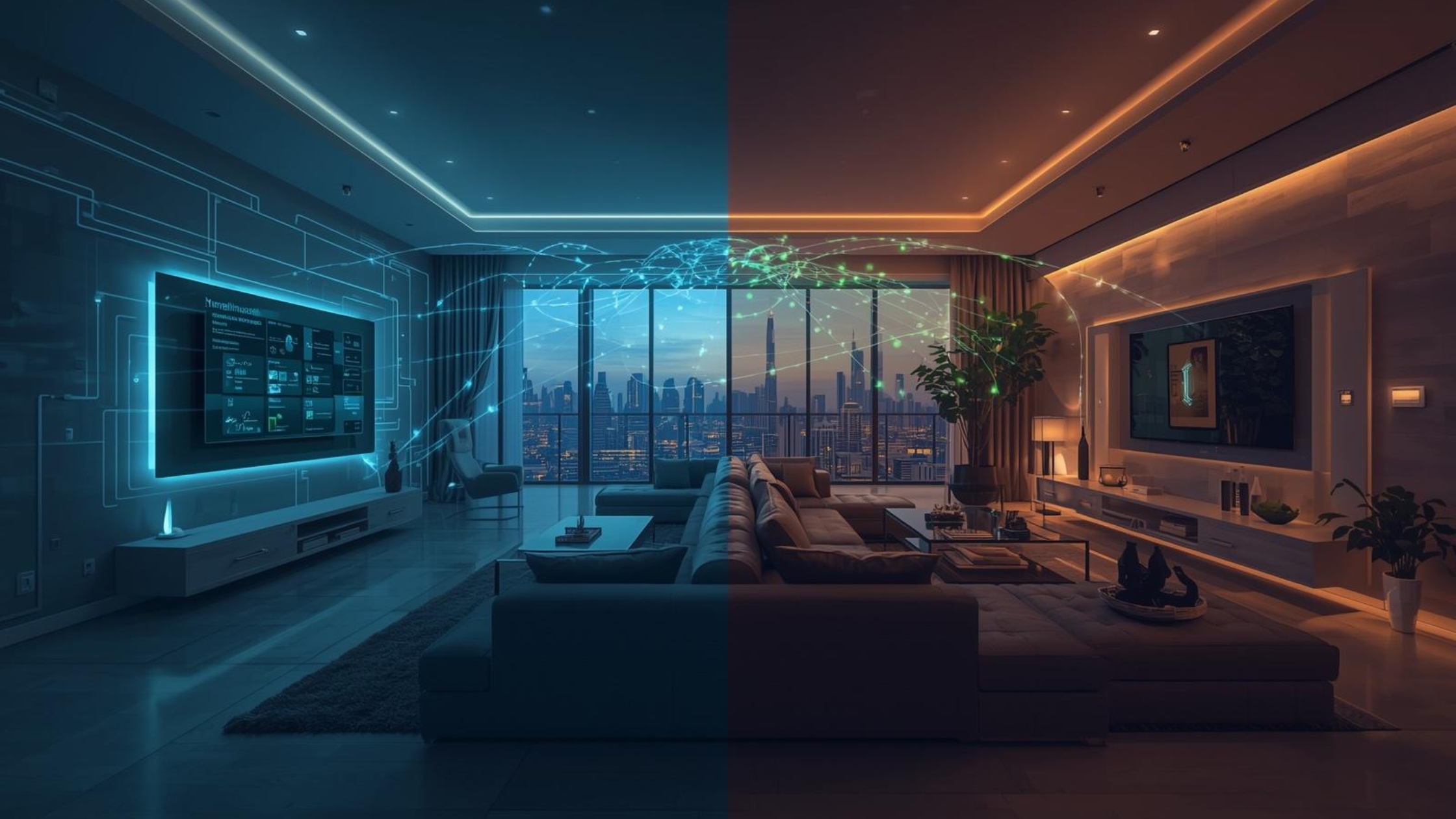
This is where most modern homes are heading. Instead of choosing wired or wireless, they combine both. Think of it like this: wired handles the core structure, wireless handles the flexible layer.
How Hybrid Works in Practice
Wired Backbone
- HVAC systems and thermostats
- Main lighting circuits
- Security infrastructure
- Network backbone (Ethernet/PoE)
Wireless Layer
- Motion and environmental sensors
- Smart locks and access control
- Voice assistants and mobile control
- Future expansions and upgrades
Why Hybrid Getting More Appreciation
- Stability where it matters: Critical systems stay wired; you don’t worry about them.
- More Flexibility: Add more sensors and wireless devices to the system without additional efforts
- Cost optimization: Wire only what absolutely needs it; expand wirelessly elsewhere.
- Future-proof design: Wired infrastructure lasts decades; wireless adapts yearly to new standards like Matter.
Common Mistakes Homeowners Make
Most people don’t get the technology wrong. They get the planning wrong.
- Choosing based only on price: Save AED 20,000 now, spend AED 40,000 upgrading in 3 years. Our solution: We design for total cost of ownership, not just upfront cost.
- Overloading Wi-Fi with devices: Network slows, connections drop, frustration increases. Our solution: We design separate mesh networks for sensors (Zigbee/Thread).
- Treating devices as separate gadgets: Messy experience, disconnected scenes, inconsistent performance. Our solution: We architect unified systems where everything works together.
- Not thinking ahead: System doesn’t scale, expensive replacements later. Our solution: We design for how you’ll use it in 5 years, not just today.
So What Should You Actually Choose?
There’s no single answer, but there is a practical way to think about it based on your situation.
Choose Wired If
- You’re building a new luxury villa from scratch
- Budget allows for professional advanced design
- You want “set it and forget it” for 10+ years
- You’re okay with professional installation and minimal DIY
Choose Wireless If
- You’re upgrading an existing home or apartment
- You want fast deployment and flexibility
- You prefer scalable, incremental investment
- You’re renting or like upgrading technology
Choose Hybrid If
- You want the most balanced long-term solution
- You’re designing a large villa or complex property
- You want both stability and future adaptability
- You have professional system architecture
For most of our clients in Dubai? We recommend starting with wireless. If you’re building new, wire the HVAC and main lighting. Everything else stays wireless. You’ll thank yourself when you want to add a sensor or upgrade technology in two years.
Final Thought: Design Matters More Than Technology
The wired vs wireless debate is slowly becoming outdated. Smart homes today are not about choosing one over the other. They’re about using the right tools in the right place.
Wired systems bring structure. Wireless systems bring adaptability. And when combined properly, they create something far more useful than either one alone.
In the end, the best smart home isn’t the one with the most advanced technology. It’s the one that simply works the way you expect it to.
Frequently Asked Questions
Is wired better than wireless?
Not always. Wired is more stable for infrastructure that never moves. Wireless is more flexible for everything else. The right choice depends on your home and goals. Most modern homes benefit from a hybrid approach. For a detailed project plan contact nizmaar home automation in Dubai
Is wireless reliable now?
Yes. Modern systems like Thread and Zigbee are very reliable when set up properly. We see 99%+ reliability in well-designed mesh networks across Dubai villas and apartments.
What’s best for existing homes?
Wireless or hybrid systems are usually the easiest and most practical. They don’t require structural changes and can be expanded over time.
Do smart homes need internet?
Some do, but many systems can still function locally without it. Wired systems definitely work offline. Modern wireless systems with local hubs (not cloud-dependent) also work without internet.
What’s the most future-proof option?
A flexible system that allows upgrades over time, usually wireless or hybrid with Matter-compatible devices. This is what we design for clients who want long-term adaptability.